Berlin · Friedrichshain

Oberbaumbrücke

This red-brick Gothic Revival double-deck bridge spanning the Spree between Kreuzberg and Friedrichshain became a symbol of reunification.
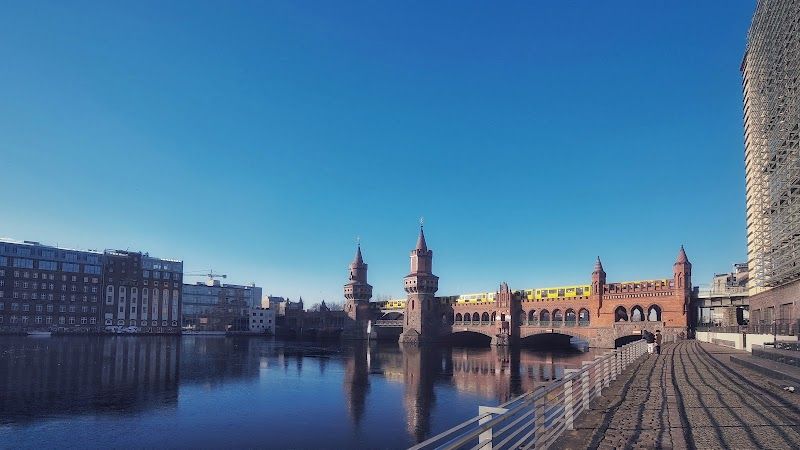
Oberbaumbrücke, Berlin · Friedrichshain
Category
Landmark
Duration
30 minutes
Best Time
Morning
Entry
The place

About Oberbaumbrücke

This red-brick Gothic Revival double-deck bridge spanning the Spree between Kreuzberg and Friedrichshain became a symbol of reunification. Once a border crossing point, the 1896 bridge carries U-Bahn trains on the upper level and vehicles below. Its distinctive brick towers and arched design make it Berlin's most photogenic bridge.

Get Ticketsvia GetYourGuide · prices may vary
Book ahead

Skip the Queue

Live availability and skip-the-line options from our booking partners.

Search on Viator →Search on GetYourGuide →

Booking powered by our partners. DAIZ may earn a commission.

The place

Getting there

Address
Oberbaumbrücke, 10243 Berlin-Bezirk Friedrichshain-Kreuzberg, Germany
Neighborhood
Friedrichshain
Nearest Metro
U5 to Frankfurter TorS-Bahn to Warschauer StrasseU1 to Warschauer Strasse
View on Google Maps →
Good to know

Tips, answered

Walk the Spree riverside path east toward Molecule Man sculpture for the classic postcard view of the bridge with its reflection in the water.

Plan for about 30 minutes. Morning visits are typically less crowded.

Oberbaumbrücke is in the Friedrichshain neighborhood of Berlin. The address is Oberbaumbrücke, 10243 Berlin-Bezirk Friedrichshain-Kreuzberg, Germany. The area is well-served by metro.

Morning visits, especially early, mean fewer crowds and better light for photos. Weekdays are significantly quieter than weekends.

Comfortable shoes are recommended. Parts are outdoors, so bring a light layer.

Around the corner

Nearby in Friedrichshain

Explore all →
East Side Gallery
Landmark

East Side Gallery

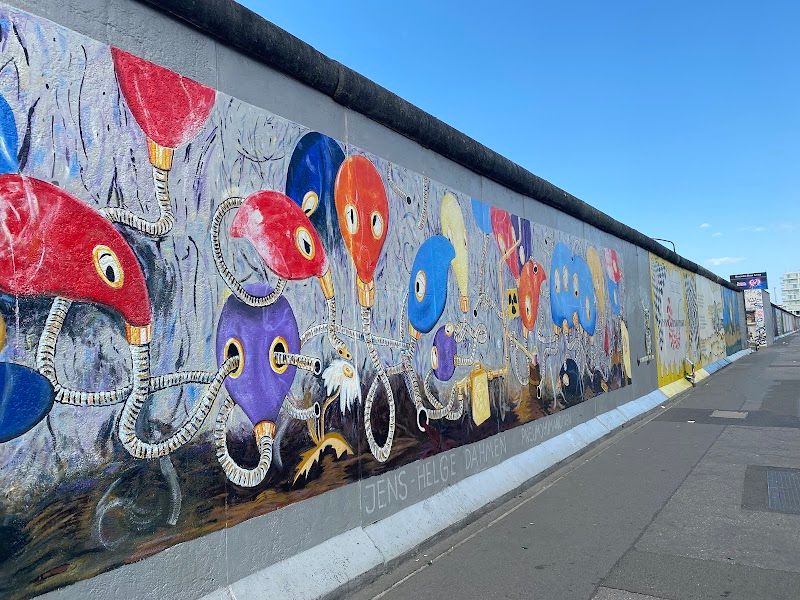
The longest remaining stretch of the Berlin Wall: 1.3 km of concrete covered in over 100 murals painted in 1990 by artists from 21 countries. Dmitri Vrubel's "My God, Help Me Survive This Deadly Love" (the Brezhnev-Honecker kiss) is the most photographed, a socialist-realist embrace between the Soviet and East German leaders that manages to be both satirical and sincere. Birgit Kinder's Trabant crashing through the Wall captures the euphoria of November 1989 in a single image. The murals were painted on the east-facing side of the Wall, the side that East Berliners could not see during the division. That detail matters. The entire gallery is a statement about freedom of expression on a surface that once represented its absence. The works have been restored multiple times (controversially, not always with the original artists' involvement), and some are fading or tagged over. Walk the full 1.3 km from Ostbahnhof to Warschauer Strasse. The Spree river runs along the other side of the Wall, and the contrast between the bright murals and the grey concrete is striking. The gallery is free, always open, and best visited in the early morning before the selfie crowds build from the Warschauer Strasse end. Weekend mornings before 10 AM give you space to actually look at the art rather than navigating around phone screens. Some of the most powerful panels are not the famous ones. Look for Kani Alavi's "It Happened in November," showing faces pressing through a crack in the Wall, and Thierry Noir's bold, cartoonish heads that were among the first paintings on the Wall, applied illegally while it was still standing.

1-1.5 hoursExplore
More on Berlin

From the blog

View all →
Ready for Berlin?

Let DAIZ plan your Berlin days

Tell us how long you've got and what you're into. We'll build a day-by-day plan, with the bookable bits ready to lock in.

Plan my Berlin tripFree · no signup to start
Plan your Berlin trip